Aether by AnswerModules is a standalone, multi-tenant SaaS service that turns business and technical requirements into real, buildable Module Suite artifacts – from forms and Content Scripts to Smart Page components, workflows, AI agents, and complete applications.
Working alongside OpenText Content Management, it provides a shared AI foundation for AI Form Builder, Content Script Builder, Component Builder, and Application Builder, allowing its models, knowledge, and capabilities to evolve without requiring platform upgrades.
More than an AI assistant, Aether combines trusted product knowledge, technical validation, traceability, and human approval to generate native, versioned objects with their existing permissions and history.
From intent to validated artifacts
Every task performed through Aether becomes a Generation Run: a persistent record of the complete generation process. First, Aether assembles the relevant context, including the existing artifact, product documentation, approved examples, templates, and material supplied by the user. A specialized AI agent then creates or modifies the required files.
Generation is grounded in a curated, versioned knowledge base maintained by AnswerModules
The Content Script API catalogue is generated directly from the product source, giving the AI access to real services and method signatures. Where authorized, Aether can also inspect the customer’s repository through a controlled, read-only connection to confirm objects, structures, and configuration instead of relying on assumptions. If a requirement is unclear, it asks the user rather than inventing an answer.
The generated result is then validated using real technical tools. If validation fails, Aether uses the diagnostics to repair the output and try again.
Nothing is published automatically: an explicit human decision is always required before the artifact becomes a new version in Content Management.
Each run also records how the artifact was produced – including the inputs, configuration, validation outcome, approval, and final published version – providing clear provenance for AI-generated work.
In short: Aether proposes; the user decides.
Four builders, one governed experience
The four Aether-powered builders provide different starting points for different roles, while sharing the same knowledge, validation, approval, and publishing process.
1. AI Form Builder
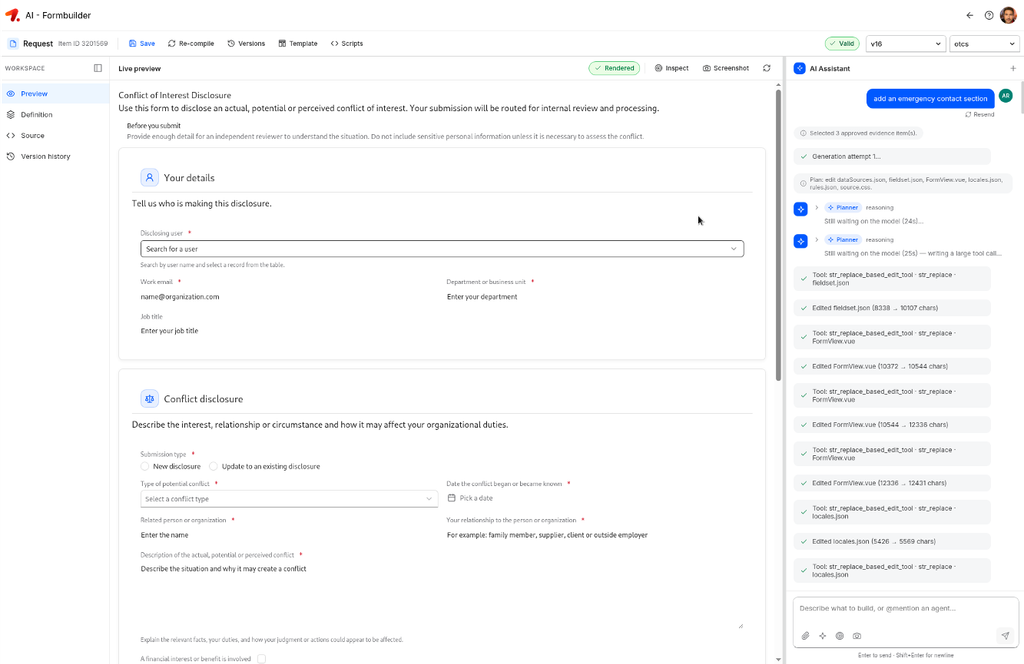
AI Form Builder turns natural-language descriptions, existing templates, PDFs, scans, screenshots, and Word documents into working digital forms. Users can refine the result conversationally, select a specific field in the preview and request a change, or use structured controls for validation, conditional rules, data sources, and translations.
The output is a readable and editable component that works with the existing Beautiful WebForms object model and submission pipeline. Existing forms remain unchanged, while AI-generated and classic views can coexist in the same environment.
2. Content Script Builder
Content Script Builder combines a redesigned development environment with AI assistance grounded in the real Content Script API. Developers can work across multiple scripts, compare versions, validate code as they type, execute scripts, inspect logs, and collaborate in real time.
The AI can create, complete, explain, and refactor code, consult approved documentation and examples, and use read-only repository information when accurate object references are needed. Every proposed change is validated and presented as a diff before acceptance.
3. Shell Pages and components
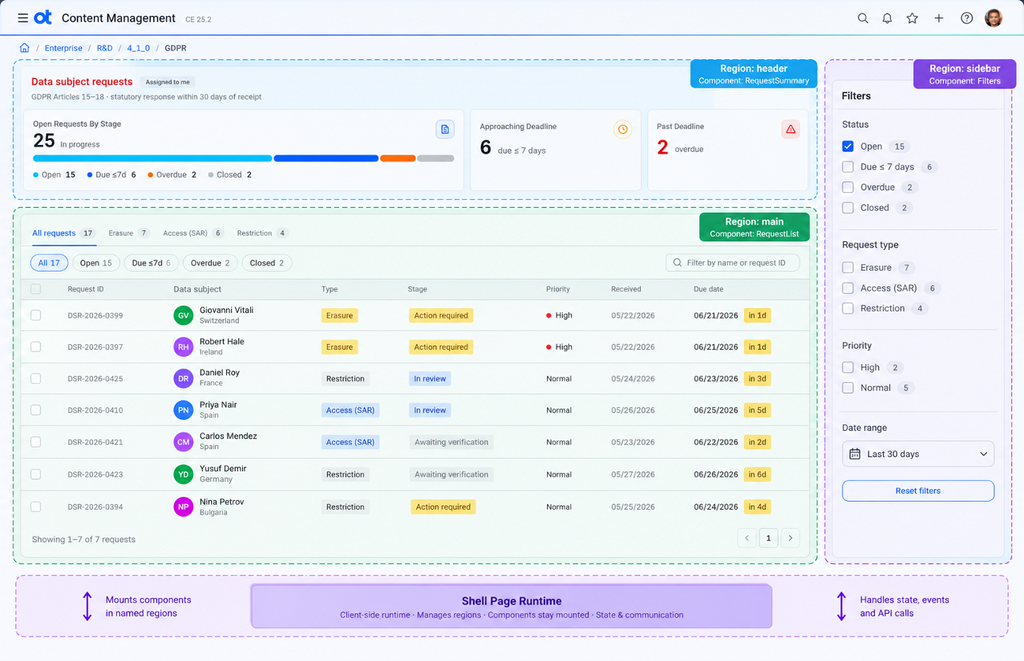
Shell Pages and components geneate reusable UI components from a description, then compiles and previews them across desktop, tablet, and mobile views.
These components support the new Shell Page model for Smart Pages. A Shell Page loads its layout once and mounts independent, reactive components into defined regions, enabling more modular, reusable, and interactive experiences. This is an additional option rather than a replacement: existing Smart Pages continue to work as they do today.
4. Application Builder
Application Builder is designed for product owners, business analysts, and users who understand the business problem but may not be developers. Starting from a project folder in Content Management, it guides them from the initial definition and requirements through architecture, component generation, review, and the final application workspace.
At its centre is the Application Manifest: a versioned source of truth describing the required forms, scripts, workflows, pages, components, AI agents, and configuration objects, along with their relationships and the requirements they fulfil. Before creating it, Aether presents a human-readable design plan for approval, helping identify misunderstandings before generation begins.
Application Builder is not an “app in one click” tool. It is a governed path from business idea to working application, with specialized AI agents doing the production work while people retain control of every decision.
Faster creation, without compromising control
Aether helps organizations move from intent to working artifacts faster, reduce repetitive development effort, and make Module Suite creation accessible to a broader range of roles. At the same time, it preserves the controls enterprise environments require: explicit approval, technical validation, traceability, standard permissions, and version management.
There is no proprietary AI silo and no dependency on Aether at runtime. Generated forms, scripts, components, and applications remain standard, readable, and editable artifacts. If an organization stops using the AI service, everything already created continues to work and can still be maintained manually.
That is the principle behind Aether: AI does the heavy lifting, while people remain in command.